
Vesna Pavlović: A Room with a View
October 17 – December 5, 2026
Opening Reception: Saturday, October 17, 4-6pm
Vesna Pavlović and Nicoletta Rousseva will also give a talk on Wednesday, October 14th, 5pm, at University of Oregon, Lawrence Hall, Room 115.
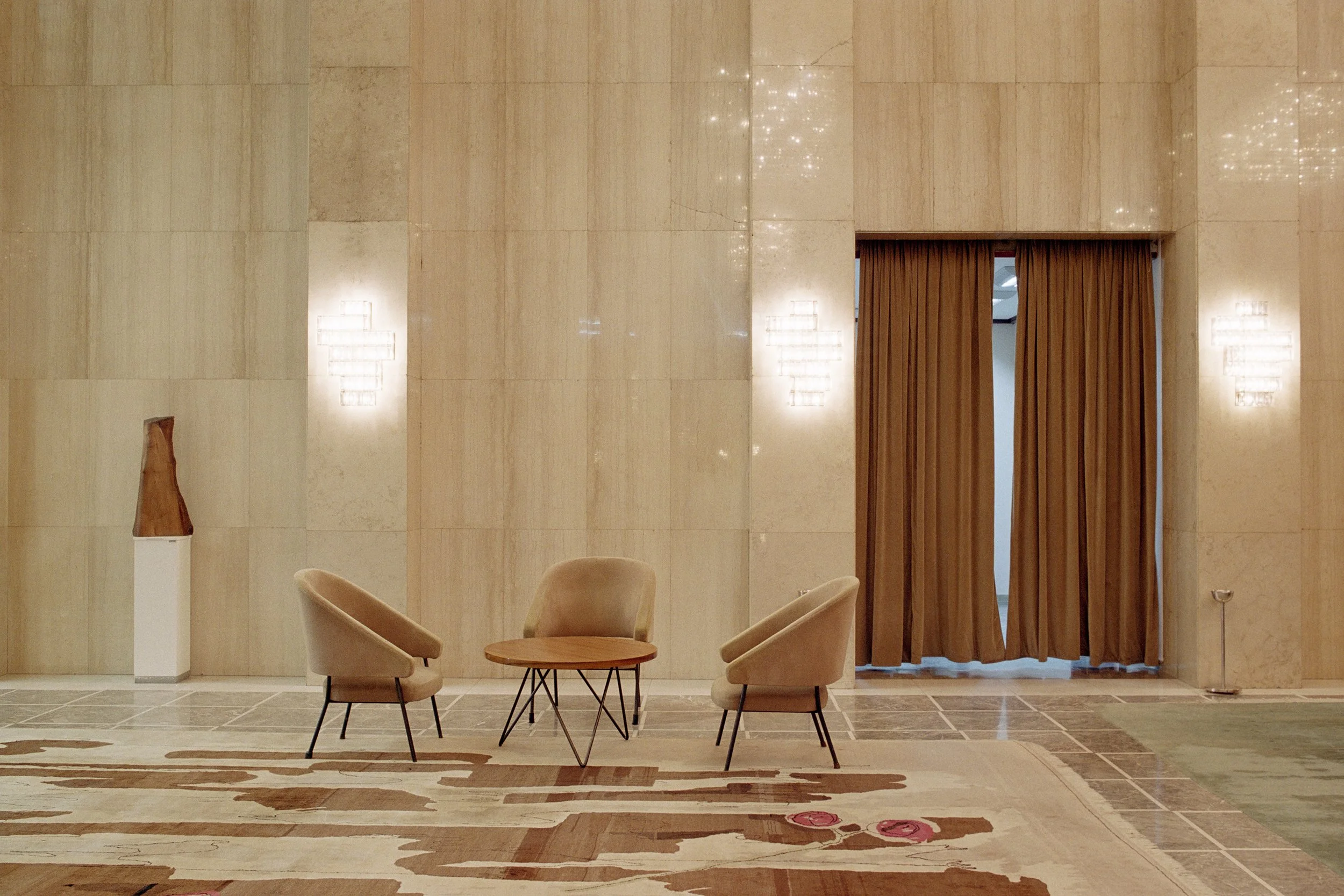
Ocher. Inside the Federal Executive Council Building, Belgrade, Serbia, From “Collection/Kolekcija” series (2003-2005), archival pigment print, 25.25 x 37.25 in, Ed. 5
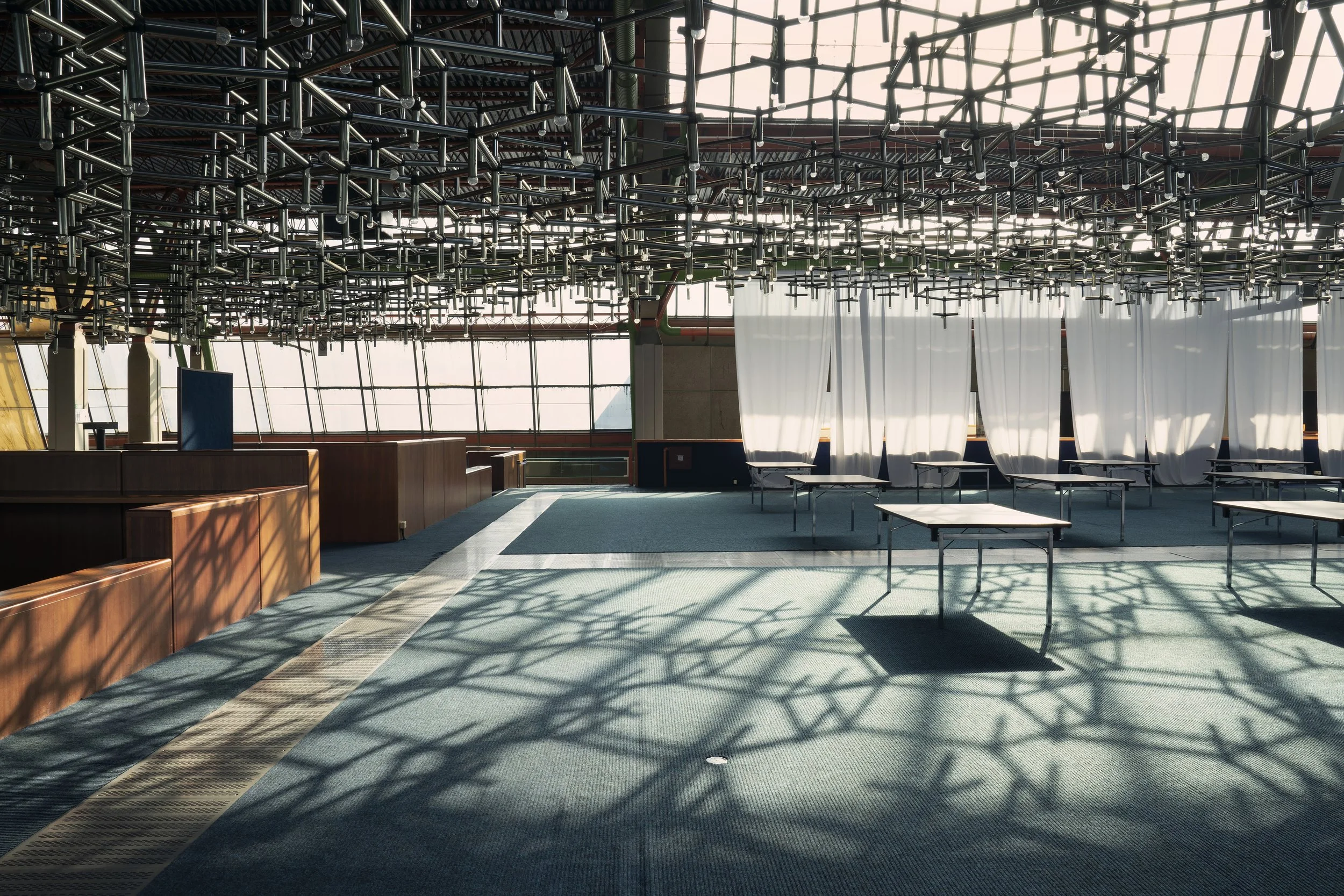
Ceiling Systems, 2019, From “Sites of Memory” series, Archival pigment print, 25.25 x 37.25 in, Ed. 5
Vesna Pavlović’s artwork delights in the task of viewing and in photography’s ability to capture a fleeting and singular yet structurally grounded view. In No Ordinary Sunset, a photograph that opens the artist’s limited retrospective at RecRoom, a fiery orange sun sinks into the Atlantic Ocean off the coast of Angola creating an intense contrast against an inky black sea. The photograph’s exaggerated depth and unobstructed view make the horizon appear boundless—as if one could watch the sun set on one side of the Atlantic and rise on the other. This expansive depth of field evokes the Non-Aligned Movement’s far-reaching vision of international anti-colonial solidarity that once connected Angola, the artist’s native Yugoslavia, and countries across the Global South.
Like No Ordinary Sunset, the photographs that comprise the exhibition Vesna Pavlović: A Room with a View showcase the care and perspicacity necessary to create captivating images and the attentiveness required to see and view with discernment. Pavlović’s work is precise in its compositional form and balance. But in equal measure, her photographs also attest to the pleasure of looking and seeing and enjoying a view of an extraordinary sunset, of an impermanent object, of a remote location, of a forgotten history, or of an unseen interior. As art critic and curator Jelena Vesić puts it, Pavlović’s photographs “display things to us.” And accordingly, part of the work’s allure resides in the vibrant tension it produces between seeing, showing, and viewing.
If, as the exhibition’s title suggests, “view” comprises one thread that sutures two decades of Pavlović’s work, then the other thread is the room. RecRoom’s domestic setting accentuates the artist’s enduring engagement with themes of interiority and interior space. Her photographs attend to the nuanced and often surprising familiarity that objects and locations can evoke, while also exploring questions of belonging and the physical and emotional spaces that rouse complex feelings of home. In doing so, Pavlović captures interiors and objects—with the Serbian word objekt denoting both a building and a thing—in a way that interweaves the architectural with the affective, binding together personal, structural, and political sensibilities.
The artist’s photographs of the Federal Executive Council building and Sava Center—monumental socialist modernist buildings in Belgrade, Serbia, that once hosted state legislatures, congresses, and foreign dignitaries—depict each site’s interior as simultaneously impressive, imposing, and vulnerable to the ravages of time. In Ocher. Inside the Federal Executive Council Building (2003, pictured upper), an embroidered pink rose on a carpet punctuates the monochromatic decor of a stately salon. In Ceiling Systems (2019, pictured lower), a twisted steel fixture hangs overhead at the Sava Center, casting fractal-like shadows that blur the line between rigid geometric structure and delicate organic form.
These photographs, like others throughout the exhibition, illuminate the contradictions inherent to political systems and institutions. Yet, rather than undercut the ambitions or ideals that animate politics as such, Pavlović’s artwork affirms the value of sites of civic architecture even while attesting to the frailty of their structural forms. Attuned to the complexity of interiority, in its spatial and emotional registers, the artist’s work depicts structures and institutions as human and humanistic endeavors that are aspirational yet imperfect, monumental yet fragile.
In doing so, her artwork resists the easy collapse of critique into disillusionment. It instead reframes institutional and international political systems, namely the Non-Aligned Movement, as spaces where ideals persist not despite, but through, their fragility and imperfections. Her photographs thus invite reflection on the enduring potency of institutional forms, the generative power of objects and places, and the embodied pleasures of seeing, showing, and viewing.
Nicoletta Rousseva
Nicoletta Rousseva is Visiting Assistant Professor of South Slavic Culture and the Michael Henry Heim Postdoctoral Fellow in the Department of Slavic and East European Languages and Cultures at Indiana University, Bloomington. A specialist on modern and contemporary art across southeastern Europe, her research examines how art engages political structures and institutions at moments of extreme crisis and in an effort to broaden narrowed horizons of possibility. Nicoletta earned a PhD in Art History with an interdepartmental concentration in Central and East European Studies at the University of Illinois, Chicago (2022). She is the recipient of fellowships from ACLS, AISEES (American Institute for Southeast European Studies), Fulbright, and the Mellon Foundation. Her essays and reviews have been published in ARTMargins, Art Journal, The Brooklyn Rail, caa.reviews, and elsewhere.